
The new class system.
Work & jobs aren't the same thing anymore.

I’m not seeing a “tough job market”. I’m seeing work resorted into a new class system. Here are the new splits:
NEW Full Video Summary (scroll down to read instead):
The Breakdown for Readers (& links):
I. Work ≠ Jobs.
For a long time, the job has been the atomic unit of work. You hired a person, they held a job and the job contained the work. The company was organized around the jobs. So was society.
That was built on the premise that tenure would equal stability.
Now in laptop work the workflow is the core. The work gets broken down into pieces and the pieces get assigned to whatever can do them best. Sometimes that is a person. Sometimes it is an agent. Sometimes it is a contractor.
The work and the job can now be related instead of being synonymous.
II. The misconception.
The panic is that work is disappearing.
Work isn’t disappearing. It is being resorted into a new class system.
For many people that resorting does not feel like a transition. It feels like an identity being threatened. It feels like confusion between dystopian headlines and the lived experience of a clunky AI rollout. It feels like layoffs looming.
For leaders it feels like the pressure to maximize efficiency while the existing work piles up. It feels like the pressure to say the right things to the board while soothing fears in the team.
III. Not everyone will move.
The gravitational pull of “how we’ve always done it” is strong.
Not every company will restructure. Some will just not see the value. Some will see it and decline. Some will talk endlessly about AI and get stuck in eternal pilots. For those companies, the work and the job will largely stay the same. The people inside them keep doing what they have always done.
Some people will leave on their own. A FlexJobs survey found 6 in 10 white collar workers said they would take a trade job for better stability and pay. Some will go because they want to. Some will go because they have to.
The point is that the concentration is real and so is the persistence of what was already there. There is no “everyone all at once” in structural transition. Only cracks that grow into canyons.
IV. The industrialization of white collar work.
Fifty years ago companies industrialized physical work. Now they’re looking to do the same with laptop work.
Just a few years ago Amazon treasured a data scientist and squeezed a distribution center worker. The data scientist had leverage. Their expertise was hard to replace. The warehouse worker didn’t have that.
Now an Amazon can squeeze both. Code is cheaper. Work that used to take a team can be done by a smaller group running tools that did not exist three years ago. The data scientist in the middle is now closer to the warehouse worker than they used to be.
The exception is a data scientist who holds a key to the recommendation engine. Or the one using AI to outproduce a team. That person is worth more than ever.
V. The direction is more clear than the speed.
There are major variables still at play here:
The cost of compute. Right now humans are cheaper in many cases and that’s with the major players burning investor cash. The tech will get more efficient but the investors will also want returns.
Trust. People like the idea of selling with AI. They hate the idea of being sold to with it. That asymmetry slows everything. Sales cycles, hiring, customer experience and internal decisions. The trust has to catch up with buzz.
Moral views on AI. Workforces, customers, boards and regulators all have a tolerance for what gets handed to a machine. People detest AI more than most leaders are pricing in.
Collective action. Unions, walkouts or bargaining don’t reverse the concentration but they bend the angle of the slope.
Data out of heads. Whether the institutional knowledge sitting in people and memory can actually be organized and available to AI systems.
The forces behind this resorting are about more than AI. Execs are being asked every day to cut faster, ship faster and find margin that was a secondary concern just a few years ago. AI gives a convenient narrative and builds on pressure that was already there.
VI. But my job title is the same.
No one is going to rename their org chart with these exact classifications. These are not job titles. These sort by leverage and scope. They are real but not conscious.
A VP of Engineering keeps being a VP of Engineering. What changes is the class of the deal underneath the title.
Leverage outside of title and tenure isn’t new. A VP of Sales who 4x’d revenue or comes from a $XXX Series B could push harder for a package than one who just hit their goal.
No one will say all of this out loud. They will do it in response to margin pressure, board questions and what they see other companies do. The sort happens as they get more aggressive about allocating resources. Saving money in CX was the goal first more than aiming to make workers feel like cogs.
Workers feel it before they have language for it. They already do.
VII. See the sort in action.
The path to that pay band is narrow and specific. It is for people who build or run the AI systems that produce what he called 100x impact. The Marquee talent.
Remaining employees will orchestrate agents rather than write code.
Same company. Same titles. A different deal in action.
VIII. The meaning.
This all means that in concentration, companies will identify first with scope and outcomes. Then with the role or seat and the person in it.
Talent will do the same. They will orient to what’s within their control. The work itself and how to extract value from it. Not loyalty to the company.
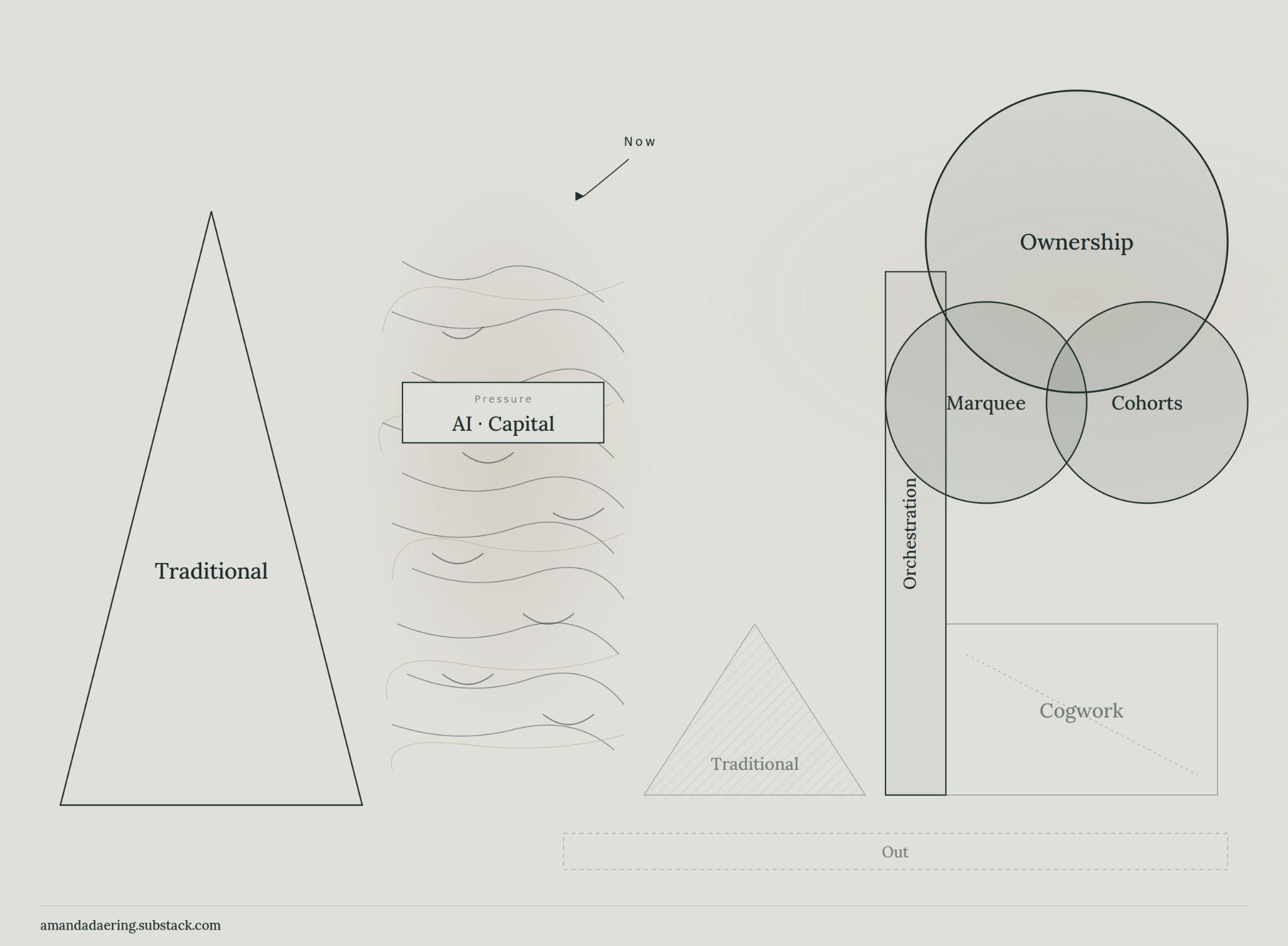
THE NEW CLASSES OF LAPTOP WORK
Ownership
People who hold the asset the work runs on. Value that used to be spread across the org flows to them. Equity is an example here. More efficient teams create more value at the ownership level.
Marquee
Talent so exceptional that the market knows them by name. Their impact is outsized and traceable which makes them expensive to lose and to get. See:
There’s another tier to this that’s just word of mouth in ecosystems. People notice where So&So goes because they’re so distinctly known for excellence. These aren’t only people who build AI or use it to 1000x. Someone’s relationships, sales ability or other outsized impact can make them marquee.
Ensembles
Groups that move together as a unit. The trust and the team is the asset. An ensemble could move internally like a squad assigned to different problems or externally from firm to firm. They could even be a powerhouse company of 10 focused on one product and intentionally lean. See:
The Star meeting with 15 disgruntled post employees. “Take Em All”.
Uptech Studios from the early Acorns team.
Hyperliquid is a team of 11 pulled from the winners of elite math competitions. They live in the space where ensembles, marquee & ownership overlap. They use “barely any AI” and generated over $800M in revenue in 2025.
Orchestration
The coordination layer running the stack of humans and AI agents together. Where a manager used to direct a team of people, the orchestrator directs a team of people and a layer of agents. See: Genpac’s ‘horizontal and vertical’ Agentic AI Officer role.
Traditional
People doing the work the way it has always been done in firms that look the way firms always have. The company stayed traditional because it couldn’t justify the upfront AI investment, was opposed to the technology or never got past the pilot stage. See: Example from law firms banning AI.
Cogwork
Work broken into pieces and run on more industrial or “blue collar” logic. Workers are more interchangeable. The exchange is more bounded and transactional in both directions. This is the tenor whether it stays as full time employment or moves to contract work. See:
Workers actively focused on Act your Wage.
Deloitte splitting benefits across literal different classifications of skilled workers.
Out
People who leave laptop work entirely. This could be opting out, career changes or people who are unable to find work again in their field. See:
Throughout this series, I’ll be breaking down each of these classes, how to see them in your org and how to know which one you’re in.
Please reply with your questions!