
Winners of the new class system.
Ensembles, ownership & marquee talent breakdown.

New here? Start here for the full overview of the new classes.
As we sort into new classes at work, not everyone misses out. Some actually win big.
This is the deep dive on the three big winners:
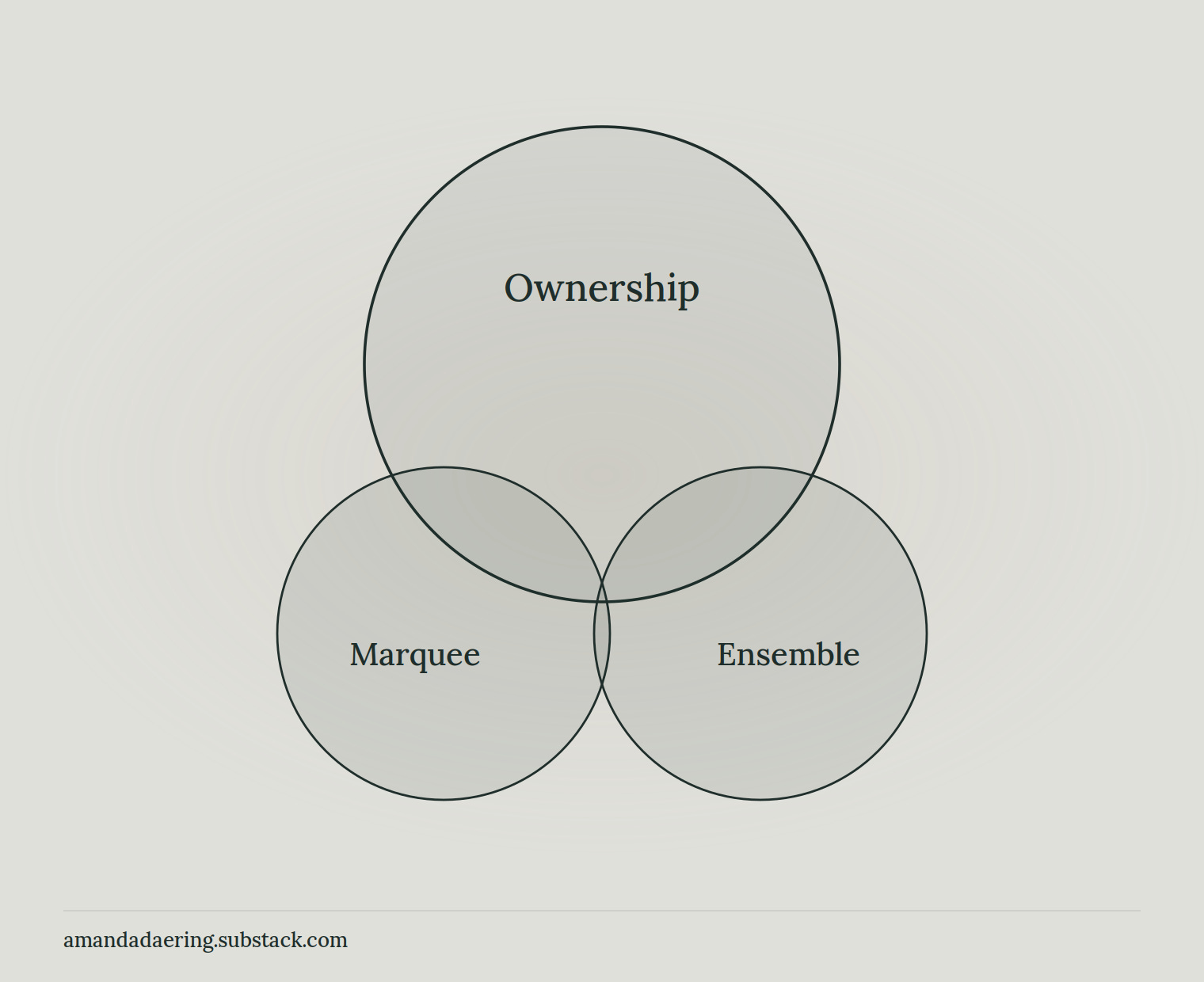
Why this is a Venn and not a Ladder
A ladder says you climb from one rung to the next and leave the last behind. The Venn says these are positions a person or a team can hold one at a time or at the same time.
The boundaries overlap because all three have leverage in different forms. Some will hold multiple types of leverage at once.
Ownership holds leverage as an asset.
Marquee holds leverage as an individual brand and impact.
Ensembles hold leverage in the trust between people.
Windsurf got sorted in 72 hours.
This is the new classes of work in action:
Marquee. Google paid roughly $2.4B to license Windsurf technology without exclusivity and hire Varun Mohan, Douglas Chen and a handful of senior researchers. The price was for who they were not what they owned.
Ensemble. Google didn’t pick the senior team off one by one. They moved as a unit because the value was the trust between them vs a single hire.
Ownership. Cognition bought what was left. The IP, the product, the brand, the customers. The asset that keeps producing.
Cogwork. The remaining 200 employees were kept long enough to transfer the IP then thinned.
One company sorted into 4 classes in 72 hours.
Marquee
Start with a school talent show with 100 kids.
For years, the show ran on effort. Everyone practiced. Everyone got a slot and the prize money got split kind of evenly. The best singer made a little more than the worst one but not by much.
Then the school posts the show online.
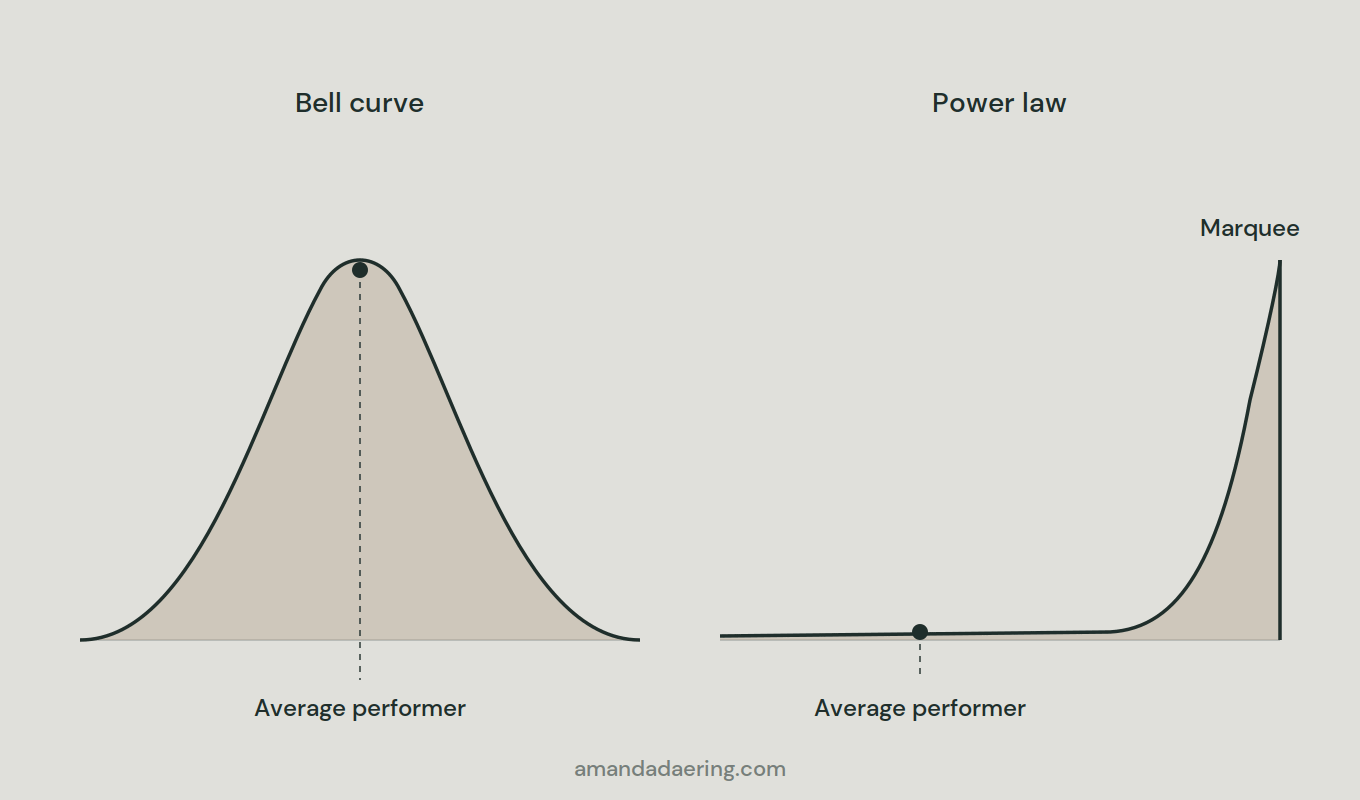
Now one kid’s video gets 2 million views. The next gets 50k. The other 98 kids together get maybe 10k. The top kid earns more from that one night than the rest of the school combined. Same talent show. Same 100 kids. Totally different payout.
Nothing about the kids changed. What changed is the system stopped rewarding effort and started rewarding reach. Once your performance could travel without you, a tiny number of performers captured almost everything.
Being pretty good stopped paying. AI multiplies whoever uses it best, lifts some of the middle into the top and strands everyone who stays merely good.
The kids with 2 million views have new leverage. They’re hard to find and hard to get and so they are expensive. They are marquee talent.
The distinguishing feature of Marquee talent is not AI. It is impact outsized enough for their market to know them by name. That could come from AI, personal access, existing relationships or other valuable skills like growth. AI accelerates this trend but it didn’t create it.
For most of the industrial era, talent paid out like a bell curve, where the strong performer earned somewhat more than the average one and most people clustered near the middle. As marquee talent pulls out and ahead, it’s a power law.
The Marquee Test
How many people that have never worked with you know your name and your work?
How many people could do what you do at the level you do it?
If you went quiet for a year, what would your market lose?
Ownership
Imagine a river town with a hundred ferrymen.
Crossing the river ran on labor. A hundred ferrymen rowed people across and each earned a fare for each trip. More crossings meant more rowing. A few ferrymen owned nicer boats and earned a bit more but the gap was bounded by how many trips a pair of arms could make in a day.
Then someone builds a bridge.
Now everyone crosses on the bridge. It cost a fortune to build and almost nothing to run. No rowing and no fares split a hundred ways. Every crossing pays a small toll and all of it flows to whoever owns the bridge. The ferrymen who used to earn a living one trip at a time are standing on the bank.
Nothing about crossing the river changed. What changed is that value stopped flowing to the labor and started flowing to the asset. Once one structure could carry what a hundred rowers used to, owning the bridge beat rowing the boat. And boat trips stopped paying.
The bridge owner has new leverage. The asset collects tolls whether they are awake or asleep and every efficiency gain lands with them instead of a payroll.
The distinguishing feature of the ownership class is that they hold the asset that the value is flowing to. AI sharpens this because the asset now does what a team of people used to. That surplus pools at the ownership level more than spreading down to wages. For most of the industrial era, owning and working sat close together because production needed people. Production used to need a lot of people. With fewer people the gap is widens between owning the asset and renting your labor to it.
As production needs fewer people then the gap between holding the asset and renting your labor to it widens.
Founding a company is only one road to ownership. Equity is an example of someone operating and owning at the same time so the person who still helps run the bridge and also holds a piece of every toll it collects. Taking on investment is an example of selling ownership for cash.
The Ownership Test
What do you own that keeps producing without you?
What is yours in a way that does not depend on permission?
Ensembles
A jazz quartet that has played together for ten years.
Any one of them is a good musician. Hire four good musicians who have never met and you get four people playing the same song at the same time. Hire this quartet and you get something none of them could play alone. They know where the others are going. They cover each other. 1+1+1+1=10
The collective is the asset. More than the talent of the four players. It’s the dynamic between them that can’t be easily replicated.
Now suddenly people can fake musical depth pretty well. Anyone can sound polished for one song so a great audition tells you less than it used to. A band that’s already played a hundred nights together becomes a strong signal. Four strangers could become that. But they might also fall apart.
The value of the Ensemble is the unit. The trust and the shared reps are the defining characteristics of the Ensemble. The rhythm doesn’t take months and years to build. You buy it.
An Ensemble can move inside a company as a squad applied to specific problems or move firm to firm. They might be an extraordinarily lean company with $MMM revenue per person. The core of the ensemble is that the bonds inside of the team strengthen and multiply value.
As noise and fraud and pressure rise then building a trusted team from scratch gets slower and riskier. A team that arrives already trusted brings speed and cohesion.
We do this with acquihiring today. We see it in the way that a new VP tends to bring in their old set of directors. Small creative agencies often move this way.
Trust isn’t a fluffy nice to have. It’s core to achievement. So as it becomes more rare and harder to build, companies will need to find more ways to buy it.
The Ensemble Test
Does your market know you as a group not just as individuals?
When you move, do you move together?
What have you built that wouldn't exist without this exact group?
These three win big.
Ownership, Marquee and Ensembles are where the leverage pools.
Look at where you’re spending. Where is leverage pooling and where is it leaking?
The rest of the sort is who it pools away from.
That’s next in this series. Reply with your questions and I’ll be doing a Q&A roundup!